


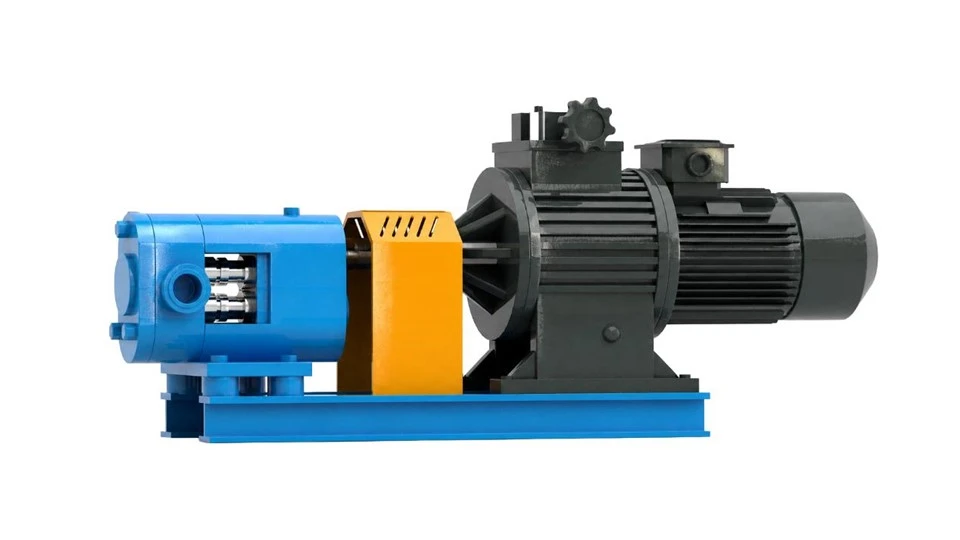
The cam-type rotary lobe pump, also known as a Roots-type pump, is a versatile, reversible positive-displacement pump. It uses two synchronized rotors to draw in and convey liquid. A pair of timing gears drives the rotors in synchronized counter-rotation. As the rotors turn on the drive and driven shafts, the pump-chamber volume changes, generating suction and discharge pressure.
The pump's core components and sealing arrangements can be made from different materials and configured to suit the properties of the pumped medium. All wetted parts inside the pump are made of stainless steel. Pump speed can be adjusted to suit the physical characteristics of the medium.
Rotary lobe pumps are widely used in household chemicals, fine chemicals, petrochemicals, food processing, coatings, pharmaceuticals, synthetic fibres, environmental protection and papermaking.
1. Positive-displacement design and consistent flow
The rotary lobe pump is a positive-displacement pump. Its displacement is directly proportional to rotational speed, making it suitable for constant-flow service. Metering accuracy can reach 1–2%. Flow does not vary with backpressure, making the pump suitable for metered transfer.
2. Strong self-priming capability
The pump has strong self-priming capability and good resistance to cavitation. Its self-priming height can reach 8.5 m.
3. Reversible pumping
The pump can convey liquid in either direction. Reversing the motor changes the flow direction without affecting the pump.
4. Wide range of compatible media
The pump can handle liquids over a wide viscosity range of 1–500,000 cP, including highly viscous liquids and suspensions containing solid particles. It can also handle media over a broad temperature range of −30℃ to +180℃.
5. Compact design and convenient maintenance
The pump head and gearbox feature a modular design for straightforward disassembly and reassembly. Adequate clearance is provided around the pump for routine maintenance.
6. Configurable options
The pump head can be fitted with heating or cooling provisions to maintain a suitable product temperature and reduce the risk of crystallization or solidification. Mechanical seals are available with options such as water or oil cooling and lubrication.
7. CIP and SIP capability
The pump design takes online cleaning (CIP) into consideration and is suitable for applications with stringent hygiene requirements. Online sterilization (SIP) is also available where the configuration permits.
- Transfer of viscous detergents, surfactants and cosmetics.
- Transfer of high-viscosity dyes, pigments, additives and resins.
- Transfer of crude oil, heavy oil, lubricating oil, bitumen and other petroleum products.
- Gentle transfer of jam, chocolate, syrup and dairy products.
- Transfer of paints, coatings and inks.
- Hygienic transfer of pharmaceutical liquids, biological products and pharmaceutical intermediates.
- Transfer of synthetic-fibre spinning solutions and slurries.
- Transfer of sludge, wastewater and other treatment-process liquids.
- Transfer of pulp, coatings and papermaking additives.
1. Operating Principle
The cam-type rotary lobe pump has two synchronized rotors driven by external timing gears. As the rotors turn in synchronized counter-rotation, the pump chamber creates suction at the inlet, drawing in the medium. Continued rotation carries the medium through the chamber and discharges it from the pump.
2. General Performance Range
|
|
|
|
0.2–1,530 m³/h |
|
|
0.1–1.2 MPa |
|
|
Up to 1.8 MPa |
|
|
Self-priming height |
Up to 8.5 m |
|
1–500,000 cP |
|
|
−30℃ to +180℃ |
3. Gearbox Lubricating Oil
- Great Wall N32
- Shell Omala 220
- Mobil Gear 630
4. Model Designation
- JTB 65-20
- Rotary lobe pump series designation.
- 65: Nominal inlet and outlet diameter, in millimetres.
- 20: Rated flow, in m³/h.
5. Installation and Operating Guidelines
- Keep the inlet line as short as practicable; a length of no more than 3 m is recommended. The pipe diameter should be one or two sizes larger than the pump port to avoid restricting inlet flow or causing cavitation.
- Install an 80–120 mesh strainer upstream of the pump. Its effective flow diameter should be greater than three times the pump-port diameter.
- Install a safety valve at the pump discharge and provide overcurrent protection.
- Fit a vacuum gauge at the inlet and a pressure gauge and flowmeter at the discharge to monitor pump operation.
- Prolonged dry running is prohibited.
- Do not operate the pump with both the inlet and discharge valves fully closed.
- Ensure that the available net positive suction head (NPSHa) is greater than the pump's required net positive suction head (NPSHr).

|
|
|
|
|
|
|
|
|
|
|
JTB 15-1 |
0.08 |
20~600 |
1 |
0.1~1.0 |
0.55~1.5 |
-0.02~0.08 |
1~500,000 |
25 |
|
JTB 25-3 |
0.16 |
20~600 |
3 |
0.1~1.0 |
1.5~2.2 |
-0.02~0.08 |
1~500,000 |
38 |
|
JTB 40-5 |
0.32 |
20~600 |
5 |
0.1~1.0 |
2.2~4 |
-0.02~0.08 |
1~500,000 |
51 |
|
JTB 50-10 |
0.66 |
20~600 |
10 |
0.1~1.0 |
2.2~7.5 |
-0.02~0.08 |
1~500,000 |
63 |
|
JTB 65-20 |
1.75 |
20~500 |
20 |
0.1~1.0 |
3~15 |
-0.02~0.08 |
1~500,000 |
76 |
|
JTB 80-40 |
3.65 |
20~500 |
40 |
0.1~1.0 |
5.5~22 |
-0.02~0.08 |
1~500,000 |
89 |
|
JTB 100-60 |
5.2 |
20~400 |
60 |
0.1~1.0 |
7.5~37 |
-0.02~0.08 |
1~500,000 |
102 |
|
JTB 125-80 |
6.8 |
20~400 |
80 |
0.1~1.0 |
11~45 |
-0.02~0.08 |
1~500,000 |
133 |
If you cannot find the required specifications or model in our product range, please contact us at any time. Our technical specialists will provide prompt model selection assistance and a customized technical solution.
Kuum tags: cam-type rotary lobe pump, China cam-type rotary lobe pump manufacturers, factory


